
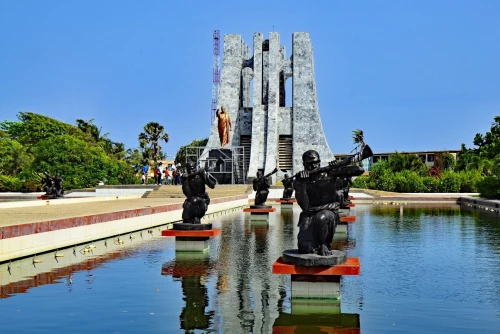
Dedicated to the memory of the late Osagyefo Dr. Kwame Nkrumah, the memorial park was built on a former British Polo field where Ghana’s independence was declared in 1957.
The Mausoleum is a magnificent Marble Monument and the last resting place of the first President of Ghana and his wife, Fathia Nkrumah.
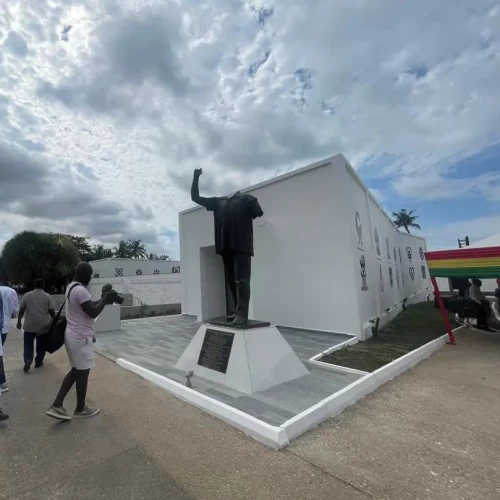
The mausoleum is the place where the mortal remains of Nkrumah have been interred for the third time in the past 39 years. The body was first buried in Guinea before being brought to Nkroful and later to the mausoleum, its final resting place. It also houses the mortal remains of Dr. Kwame Nkrumah’s wife Fathia Nkrumah.
The structure resembles swords which have been turned upside down which is a symbol of peace. Others also view it as an uprooted tree, signifying the unfinished works of Nkrumah. The mausoleum designed by Don Arthur.
The mausoleum is clad from top to bottom with Italian marble, with a black star at its apex to symbolize unity. The interior of the Mausoleum boasts marble flooring and a mini mastaba looking marble grave marker surrounded by river-washed rocks.
A skylight at the top in the Mausoleum illuminates the grave, and at the night time, seems to reflect off the marble further emphasizing that beauty many have come to fall in love with. As part of the redevelopment, new lighting was added that gives a beautiful view at night.
The Mausoleum is surrounded by water which is a symbol of life. Its presence conveys a sense of immortality for the name Nkrumah. It shows that even in death he lives on in the hearts and minds of generations here and generations yet to come.
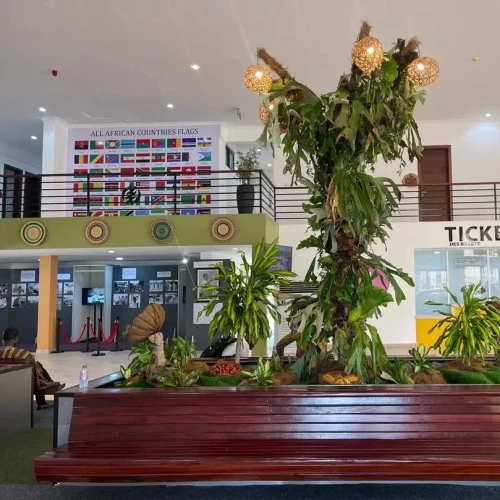
The museum, on the other hand, accommodates the personal belongings of Nkrumah. These include books he wrote, photograph archives and official photographs. A photo collection features pictures of Nkrumah with several renowned leaders of his time. Some of them are; Pope Pius XII, Queen Elizabeth II and President John Kennedy of the United States, just to mention a few.
Also in the museum is the metal coffin donated by the people of Guinea when the remains of Nkrumah were returned from Romania to Guinea and later to Nkroful.
The museum saw addition in the redevelopment with a walk-through digital museum which depicts speeches of Nkrumah prior to independence, independence and post-independence.